2a Warehouse: Strategy for Growing Shopify
Discover how choosing the right 2A warehouse strategy can scale your Shopify store. Learn fulfillment tactics, location benefits, and how Forthmatch connec
Hylke Reitsma is co-founder of Forthsuite and a supply chain specialist with 8+ years of hands-on experience at Shell, Verisure, and Stryker. He holds an MSc in Supply Chain Management from the University of Groningen and writes practical guides to help e-commerce teams run leaner, faster supply chains. Selected by Replit as 1 of 20 founders for the inaugural Race to Revenue Cohort #1 (2026) and certified as a Replit Platform Builder.
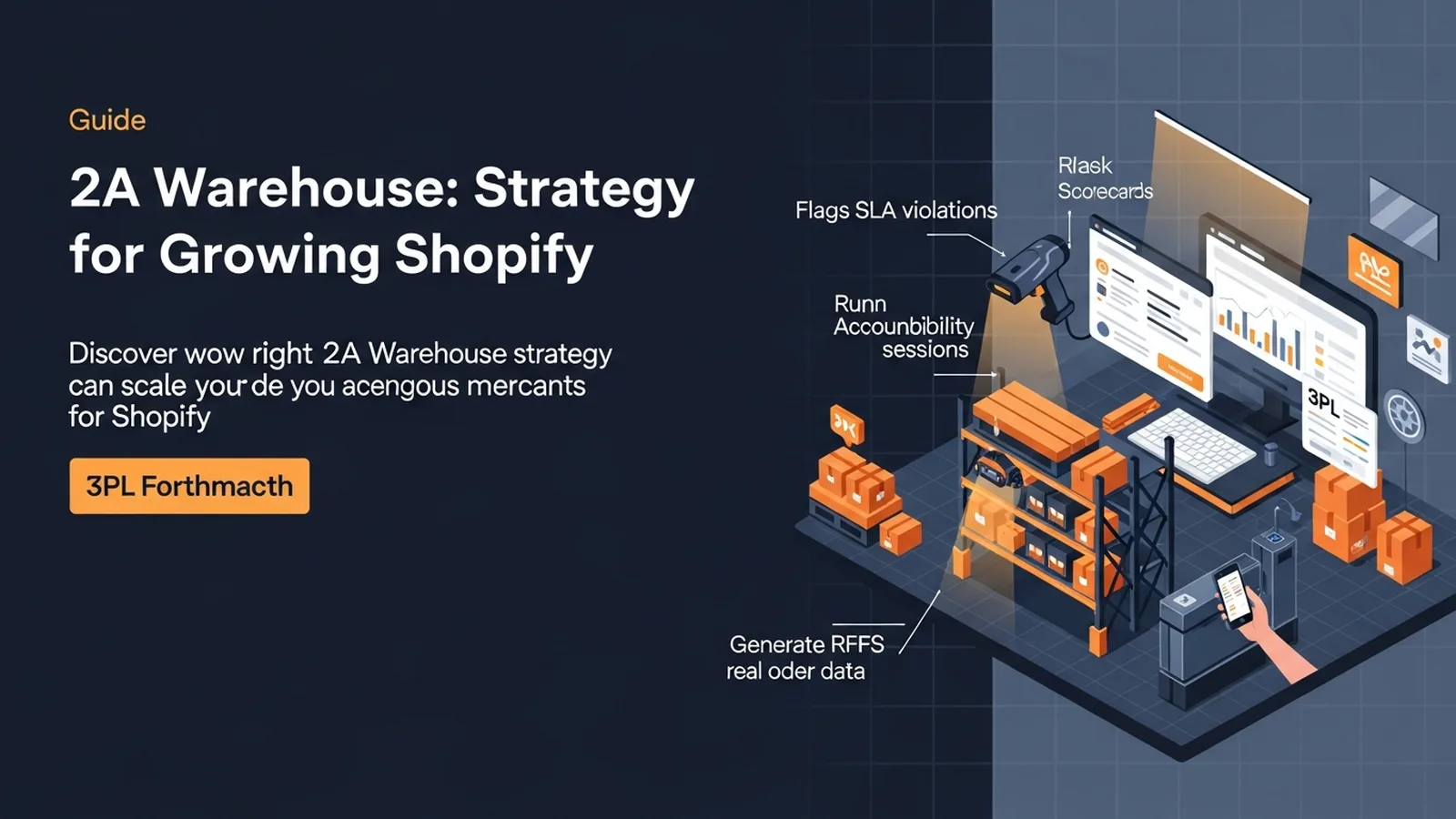
TL;DR: A 2a warehouse strategy involves using a secondary fulfillment location to reduce shipping times, lower costs, and improve delivery zones for growing Shopify stores. Forthmatch helps Shopify brands implement effective multi-warehouse strategies by matching them with the right 3PLs and tracking fulfillment partner performance across all locations.
Last updated: July 2026
A 2a warehouse strategy for growing Shopify businesses centers on splitting inventory between fulfillment centers positioned near major population clusters. This approach cuts shipping times by 1-2 days and reduces zone-based carrier costs by 15-30%, making it one of the most effective ways to compete with Amazon's delivery speeds. If you're shipping 500+ orders monthly and seeing cart abandonment at checkout due to slow delivery estimates, a two-warehouse system solves this without the complexity of managing four or five regional facilities. Platforms like Forthmatch help merchants identify which 3PL partners offer cost-effective multi-location fulfillment and track performance across both warehouses.
Understanding 2a Warehouse Distribution for Shopify Growth
The "2a" designation refers to maintaining two active warehouses in separate geographic zones. For US-based Shopify merchants, this typically means one facility on the West Coast (California or Nevada) and one in the Central or Eastern region (Texas, Pennsylvania, or New Jersey).
This configuration provides 2-day ground delivery to approximately 85% of the US population, compared to 45-60% coverage from a single central warehouse.
The math behind this strategy is straightforward. USPS Priority Mail and UPS/FedEx Ground rates increase by roughly $2-4 per package when shipping crosses from Zone 4 to Zone 7. A merchant shipping 1,000 packages monthly at an average of $3 additional cost per cross-country shipment pays $36,000 annually in avoidable carrier fees. Add the revenue impact of faster delivery, and the business case becomes clear.
However, splitting inventory between two locations creates operational complexity. You need systems to route orders intelligently, maintain accurate stock counts across both facilities, and monitor whether each warehouse performs consistently. Poor execution leads to split shipments (sending one order from two locations), stock imbalances (popular items sitting in the wrong warehouse), and customer service headaches.
When 2a Warehouse Strategy Makes Financial Sense for Growing Shopify Stores
Not every Shopify business benefits from two warehouses. The breakpoint typically occurs between 400-800 monthly orders, depending on your average order value and product margins. Here's how to calculate your specific threshold:
Start with your current shipping costs per zone. Pull three months of carrier invoices and calculate your average cost to ship to Zones 1-4 versus Zones 5-8. Most merchants see a $2.50-5.00 difference per package. Multiply this by the percentage of your orders shipping to distant zones. If 40% of your orders travel across the country and you ship 600 packages monthly, that's 240 packages × $3.50 = $840 monthly in excess zone charges, or $10,080 annually.
Now add the cost of operating a second warehouse. Most 3PLs charge $300-800 monthly as a base facility fee, plus $4-6 per order for pick-and-pack. If your current 3PL charges $5 per order, adding a second location might cost $500 base fee + $5 per order for the 240 packages now routing through the second facility. That's $500 + $1,200 = $1,700 monthly, or $20,400 annually.
In this scenario, the numbers don't work yet. But at 1,200 monthly orders with the same zone distribution, you're saving $20,160 in shipping while spending $20,400 in additional 3PL fees. You're near breakeven on hard costs, and the competitive advantage of faster delivery tips the scale. At 1,500+ orders monthly, the savings clearly outweigh the costs.
Also consider your product characteristics. Heavy items (over 5 pounds) see larger zone-based price jumps, making two warehouses profitable at lower order volumes. Fragile products benefit from shorter transit times and fewer handoffs. Fast-moving consumables with predictable demand patterns are easier to stock correctly across two locations than seasonal fashion items.
Selecting the Right Geographic Locations for Your 2a Warehouse Setup
Location choice directly impacts your zone coverage and shipping costs. The most common successful configurations for US Shopify merchants are:
- Los Angeles + Pennsylvania: Covers both coasts with strong population density. Provides 2-day ground to 87% of the US population. LA handles West Coast and Mountain states; PA covers Northeast, Midwest, and Southeast.
- Nevada + New Jersey: Similar to LA/PA but often with lower warehouse costs. Nevada has no inventory tax, and Northern NJ offers proximity to New York metro without NYC costs.
- California + Texas: Texas provides central access to Southern states and faster routing to Midwest. Works well if you have significant Southern customer concentration.
- Nevada + Georgia: Georgia's Atlanta area offers excellent carrier infrastructure and lower labor costs than Northeast facilities.
Run your actual order data through a zone analysis before committing to locations. Export six months of shipping addresses from Shopify, then use a tool to map zip codes to carrier zones from potential warehouse locations. This reveals your actual coverage. Some merchants discover their customer base concentrates in specific regions, making non-standard location pairs more effective.
Also verify that your 3PL operates facilities in both locations or can coordinate between partner facilities. Some fulfillment providers offer multi-location services where they manage inventory allocation and order routing between their own warehouses. Others require you to contract with separate 3PLs and handle coordination yourself, which adds operational burden.
Inventory Allocation Methods Across Two Warehouses
Splitting inventory correctly prevents the costly problem of receiving an order for a product that's stocked in the distant warehouse. You have three main allocation approaches:
Proportional distribution mirrors your order volume by region. If 55% of orders ship from your East warehouse and 45% from the West, you stock inventory in roughly the same ratio. This is simple to calculate and works well for businesses with consistent regional demand patterns. Calculate the ratio quarterly and adjust during inventory replenishment cycles.
Demand-based allocation analyzes where customers for specific SKUs are located. Some products may have regional preferences. Outdoor gear might sell disproportionately in mountain states, while beach accessories concentrate in coastal markets. Pull SKU-level sales data by shipping state, then weight inventory placement accordingly. This requires more sophisticated analytics but can reduce split shipments by 20-30%.
Dynamic rebalancing moves inventory between warehouses based on real-time stock levels and order patterns. When the West warehouse runs low on a fast-moving SKU while the East has excess, you transfer units. This maximizes inventory efficiency but adds complexity and transfer costs. Most merchants start with proportional distribution, then add dynamic elements as they scale beyond 3,000 monthly orders.
Whatever method you choose, maintain minimum stock levels at both locations for your top 20% of SKUs. These items generate 80% of order volume (classic Pareto distribution), so having them available at both warehouses prevents most split shipments. Slower-moving items can stock in just one location, accepting occasional cross-country shipments for these less frequent orders.
Set reorder points that account for lead times to both warehouses. If your supplier ships from China, containers typically arrive at West Coast ports 14-18 days before East Coast ports. Factor this into your inventory planning to avoid stockouts during the ocean transit differential.
Technology and Systems for Managing Multi-Warehouse Operations
Your technology stack needs to handle order routing, inventory visibility, and performance tracking across both facilities. Shopify's native multi-location inventory feature provides basic functionality, letting you assign inventory quantities to different locations and set priorities for order fulfillment.
However, most growing merchants need more sophisticated routing logic. Third-party apps like Extensiv (formerly 3PL Central) or ShipHawk connect to multiple 3PLs and route orders based on rules you define: closest warehouse with inventory, lowest shipping cost, or fastest delivery time. These platforms cost $200-800 monthly but save far more in prevented split shipments and optimized carrier selection.
Your 3PL's warehouse management system (WMS) must integrate cleanly with Shopify through API connections or EDI. Look for real-time inventory updates (within 15 minutes of picks and receipts) rather than daily batch updates. Delayed inventory data causes overselling and customer disappointment.
For analytics, you need dashboards showing performance by warehouse: order accuracy rates, same-day ship percentages, average pick times, and damage rates. Forthmatch contributes fulfilment success rate, processing time and SLA compliance from Shopify data. Obtain picking accuracy, same-day shipping and damage measurements from your warehouse records; those are separate from Forthmatch’s supported metrics. If your East warehouse ships 95% of orders same-day while the West manages only 78%, you have a clear operational problem to address.
Consider implementing these specific tracking metrics per warehouse: inventory accuracy (cycle count variance), order fulfillment speed (hours from order placement to carrier pickup), return processing time, and customer location vs. fulfilled location mismatch rate. The last metric reveals how often you're shipping from the "wrong" warehouse, indicating inventory allocation issues.
Coordinating with 3PLs for 2a Warehouse Strategy Implementation
Finding 3PL partners who can execute a two-warehouse strategy requires evaluating several factors beyond basic pricing. Start by confirming they have experience with multi-location fulfillment for Shopify merchants.
Ask for references from clients running similar configurations and inquire about specific challenges those clients faced.
Negotiate pricing that accounts for your split volume. Some 3PLs offer volume discounts that apply across all their facilities, meaning your combined 1,500 monthly orders get better per-order rates even though they're split 800/700 between locations. Others treat each facility as a separate account with separate minimum order requirements. The pricing structure can swing your monthly costs by $500-1,000.
Discuss inventory receiving and transfer processes upfront. How do they handle situations where you need to move 200 units of a product from the overstocked warehouse to the one running low? Some 3PLs charge $1-2 per unit for outbound transfers plus inbound receiving fees at the destination facility. Others include reasonable transfers as part of the service. Get these costs in writing before signing contracts.
Establish SLAs (service level agreements) for both warehouses. Require the same performance standards at each location: 99.5% order accuracy, 95% same-day shipping for orders received before 2 PM, 48-hour return processing. Monitor these metrics weekly during the first three months after launching your second warehouse, then monthly once operations stabilize.
Plan for the transition period when you're moving from one warehouse to two. You'll need to ship inventory to the new facility, test integrations, and run parallel operations briefly. Most merchants take 4-6 weeks from signing a 3PL contract to shipping customer orders from the new warehouse. Budget for this ramp-up time and consider launching the second location during a slower seasonal period rather than right before Black Friday.
Measuring ROI and Optimizing Your Two-Warehouse Strategy
Track specific metrics to validate whether your 2a warehouse strategy delivers the expected returns. Calculate your actual shipping cost per order before and after implementing two warehouses.
Include the base rate, fuel surcharges, and accessorial fees. Many merchants find their per-order shipping costs drop by $1.50-3.00, which compounds quickly at scale.
Monitor your average delivery time by analyzing carrier tracking data. Measure the percentage of orders delivered within 2 days, 3 days, and 4+ days. A successful two-warehouse system should increase your 2-day delivery rate from roughly 50% to 80-85% without using expensive expedited services.
Track conversion rate changes at checkout. Use Shopify's analytics to compare conversion rates before and after you start displaying faster delivery estimates to customers in different regions. Some merchants see 3-8% conversion rate improvements when they can promise 2-day delivery instead of 4-5 days.
Watch for hidden costs that can erode your savings: split shipments to the same customer (should be under 2% of orders), inventory transfer fees between warehouses, and carrying costs from maintaining safety stock at both locations. If you're regularly splitting shipments or moving inventory weekly between facilities, your allocation strategy needs adjustment.
After six months of operation, run a complete cost-benefit analysis. Add up total shipping costs, 3PL fees, inventory carrying costs, and technology expenses for your two-warehouse system. Compare this to projected costs if you had stayed with a single warehouse (using your actual order volume and destinations). The difference should show at least 10-15% improvement in total fulfillment costs, or the competitive advantages should clearly justify the investment through higher conversion rates or customer retention.
Continuously optimize by analyzing which products generate the most cross-country shipments and adjusting their inventory allocation. Review your warehouse locations annually as your customer base evolves. A business that initially served customers evenly across regions might find growth concentrating in specific markets, making a location change worthwhile.
Finding the right 3PL partners and managing multi-warehouse performance requires solid data and ongoing analysis. Forthmatch gives Shopify merchants the tools to compare 3PL options, monitor fulfillment performance across multiple locations, and make informed decisions about when to expand or consolidate warehouse operations. Find your ideal 3PL partner and track their performance effectively. Try Forthmatch free at forthmatch.io.
Track how your current 3PL actually performs — Forthmatch, free for Shopify stores.
Frequently Asked Questions
What is a 2a warehouse and how does it help grow my Shopify business?
A 2a warehouse is a strategic fulfillment approach where inventory is split between two locations to reduce shipping times and costs. For Shopify merchants, this strategy accelerates delivery speeds, lowers zone-based shipping fees, and improves customer satisfaction. By positioning products closer to your customers, you can compete with major retailers while scaling efficiently. Platforms like Forthmatch help identify optimal 3PL partners for implementing this dual-warehouse strategy effectively.
How do I know if my Shopify store is ready for a 2a warehouse strategy?
Your Shopify store is ready for a 2a warehouse strategy when you're shipping over 500 orders monthly with customers distributed across different regions. Analyze your shipping data for geographic concentration and high shipping costs. If you notice long delivery times or frequent zone 5-8 shipments, it's time to consider splitting inventory. Forthmatch's analytics can identify these patterns so you can target 3PLs that support multi-location fulfillment efficiently.
What are the main benefits of using a 2a warehouse approach for Shopify fulfillment?
The primary benefits include 30-50% reduced shipping costs through lower zone fees, faster delivery times averaging 2-3 days instead of 5-7, decreased cart abandonment due to reasonable shipping rates, and improved customer retention. Additionally, you'll gain competitive advantage against larger retailers, reduce the risk of regional disruptions, and create redundancy in your supply chain. This strategy directly impacts your bottom line and customer experience metrics.
How does Forthmatch help me implement a 2a warehouse strategy for my Shopify store?
Forthmatch analyzes your Shopify order data to identify optimal warehouse locations based on customer distribution patterns. The platform provides performance analytics to track shipping costs, delivery times, and fulfillment accuracy. Forthmatch eliminates the guesswork by comparing 3PL pricing, capabilities, and geographic coverage, ensuring your 2a warehouse strategy is data-driven and cost-effective from day one.
What challenges should I expect when setting up a 2a warehouse for my Shopify business?
Common challenges include initial inventory allocation decisions, maintaining adequate stock levels across both locations, coordinating with multiple 3PL partners, and managing increased complexity in fulfillment operations. You'll also need to implement smart routing logic and monitor performance metrics closely. However, using a platform like Forthmatch simplifies these challenges through centralized analytics, 3PL performance tracking, and data-backed recommendations for inventory distribution and partner selection.
What warehouse strategy should a growing Shopify brand use?
A 2a warehouse strategy involves using a secondary fulfillment location to reduce shipping times, lower costs, and improve delivery zones for growing Shopify stores. Forthmatch helps Shopify brands implement effective multi-warehouse strategies by matching them with the right 3PLs and tracking fulfillment partner performance across all locations.
About the Author

Hylke Reitsma is co-founder of Forthsuite and a supply chain specialist with 8+ years of hands-on experience at Shell, Verisure, and Stryker. He holds an MSc in Supply Chain Management from the University of Groningen and writes practical guides to help e-commerce teams run leaner, faster supply chains. Selected by Replit as 1 of 20 founders for the inaugural Race to Revenue Cohort #1 (2026) and certified as a Replit Platform Builder.
LinkedIn